For information on our floor plans and pricing, available options, or city and county fees required to develop your property, email us, call (305) 872-9520, or stop by the office on the corner of Key Deer Blvd. and Pond Lane, Big Pine Key.
- 8 ft. x 16" x 16" solid poured columns with four #6 reinforced steel rods (includes 8 ft. auger holes)
- Stainless steel anchor plates
- Triple 2" x 12" pressure treated rim joists
- 2" x 10" pressure treated floor joists nailed 16" on center
- 3/4" plywood sub-floor nailed 16" on center
- 2" x 6" nailed 16" on center with 5/8" plywood sheathing and vapor barrier on exterior walls
- Impact windows and doors
- 1/2" drywall finished and painted
- 2" x 4" interior walls 16" on center
- R30 fiberglass insulation in roof
- Roof truss system 2" x 4" with 5/8" plywood sheathing
- R19 fiberglass insulation in exterior walls
- 4 ft. wide landing and pressure treated staircase
- Finished drywall, carpentry, plumbing and electric with White fascia and soffit
- 180 mph wind loads per municipal building code
- 3/12 roof pitch with Asphalt shingle roof
- HVAC 14 seer installed
- Platform and deck for AC compressor
- Stainless Steel appliance package including refrigerator, range, microwave and dishwasher
- Vinyl tile flooring throughout
- Dutch Lap vinyl siding
- Cabinets in the kitchen and bathrooms
- Laminate counter tops in kitchen and bathrooms
- Brushed Nickel faucets and bath accessories
- Satin Nickel light fixtures
- Street tree and swales
- Metal roof
- Higher roof pitch than a 3/12 fixed roof
- Hardie cement board or stucco exterior finish
- Ceramic or porcelain tile floors
- Granite or Quartz Countertops
- Tile shower/ tub surround
- Downstairs enclosure
- Ground slab under house
- Composite Decking
- Site Built Porches
- Fiberglass Insulation — 6" or R19 in the 2" x 6" Exterior Walls and 9" or R30 Ceiling Insulation
- Fiberglass Entry Door
- Vapor Barrier in Ceiling and Walls
- Impact Doors and Windows Standard
- Caulking at Windows and Doors to Reduce Air Infiltration
- Polystyrene Air Baffles in Rafter Spaces to Provide Air Flow in Attic (Only 3-5/12 Roof Pitch)
- Continuous Soffit and Ridge Vent Exceeds Code Requirements for Ventilation
- Caulking at Wall to Floor, Wall-to-Wall and Wall-to-Ceiling Connections to Reduce Air Infiltration
- Appliance Packaged Included
- Energy Saver Water Heater
- Water Saver Faucets, Shower Head and Water Closet
The main benefits of System-Building are:
- The builder is better able to control costs for the homeowner.
- Homes are completed faster.
- Homes are built in a controlled environment minimizing
weather damage and theft at the job site.
A typical system-built home is comprised of two to four units. System-built homes are built following local building codes and use proven building techniques. The first step is to build components in our state of the art production facilities and assemble them into three dimensional units. We complete most of the exterior and interior of the units in our plants. On the exterior of the units we install the windows and most of the siding, shingles and other architectural details. On the inside of the units we install all of the wiring, plumbing, insulation and sheet rock. After drywalling is complete, we install plumbing fixtures, light fixtures, cabinets, counter tops, interior doors and trim.
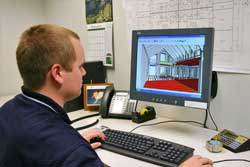
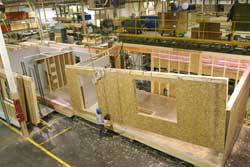
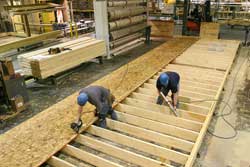
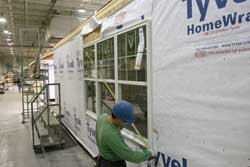
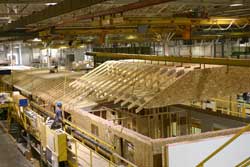
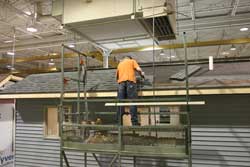
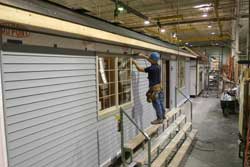
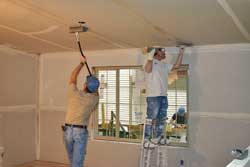
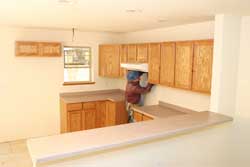
At the job site, the builder coordinates the placement of the units onto the foundation with a crane. After the units are in place, the builder seals up the roof. On the outside, the builder assembles the garage components and installs all of the siding, shingles and architectural treatments that were not installed at the plant. On the inside, the builder finishes off the connection between the units and coordinates installation of carpeting and other miscellaneous items.
Mobile Home Construction refers to a building method where the home is built according to a national HUD code instead of the local building code. This code allows mobile homes to be built with different and often lesser quality standards than regular houses. The goal is to provide housing that is more affordable than regular housing. The main disadvantages of mobile homes are that they depreciate in value, they do not qualify for conventional mortgages and insurance costs are higher. The characteristic that is most unique to mobile homes is that the floor is a metal chassis with removable wheels that is used to transport the home to the job site.
The only similarities between the two methods of construction are that the homes are built as units and they are both built in factories.
Many mobile home companies also produce modular homes in the same factory. These modular homes built by mobile home companies are built according to local building codes but often contain the same lesser quality materials and are built with the same lesser quality standards as mobile homes.
The homes that Sweetwater Homes, Inc. builds meet or exceed all county and city building codes and guidelines.